Engineering note
Frontend Architecture: The Mental Model That Keeps Complex Apps Maintainable
Good architecture is not about picking the right folder structure on day one. It is about having clear boundaries so every new feature knows where to live and every bug knows where to get caught.

Article focus
5 pillars
A framework you can apply today
Key takeaways
- 01Five pillars - component design, state management, API contracts, testing strategy, tooling - form a complete frontend architecture.
- 02Each pillar is a forcing function for the others; strong contracts simplify testing, clear state boundaries simplify components.
- 03Start with the pillar your team feels most pain in today. The rest follow naturally.
Why do frontend codebases get harder to change over time?
Because boundaries degrade silently. Every shortcut crosses a layer, and after enough shortcuts the system has no layers at all.
I have walked into codebases where pages fetch data directly inside onClick handlers, component files span two thousand lines, and the same API response is parsed in four different places. None of these problems appeared on day seven. They appeared on day seven hundred, after the "just this once" compromises piled up.
The fundamental challenge of frontend architecture is that the cost of a bad decision is deferred. A leaky component, a state without a clear owner, a hardcoded URL - each one is invisible in isolation. But together they create a system where adding a simple feature requires touching eight files and praying you did not break something unrelated.
The fix is not a rigid plan. It is a shared mental model about where responsibilities live and how they communicate.
The 5 Pillars Interactive
Click any pillar to learn more and jump to its full deep-dive.
Component Design
Primitives own look, product components own intent, pages wire everything together.
State Management
Server state, URL state, local state, global state - each with one clear owner.
API Contracts
Shared types between frontend and backend turn mismatches into compile errors.
Testing Strategy
Integration tests give the most confidence per line. Unit for logic, E2E for critical paths.
Tooling & Monorepo
Shared configs, build caching, and package boundaries that scale with the team.
Click a pillar to expand and learn more.
The five pillars of frontend architecture
Component design, state management, API contracts, testing strategy, and tooling - interconnected disciplines that together keep a codebase stable and fast to change.
Over years of building and rebuilding frontend systems - React, Next.js, vanilla, you name it - I have landed on five areas that matter most. They are not a checklist to implement in order. They are muscles to develop as your project grows.
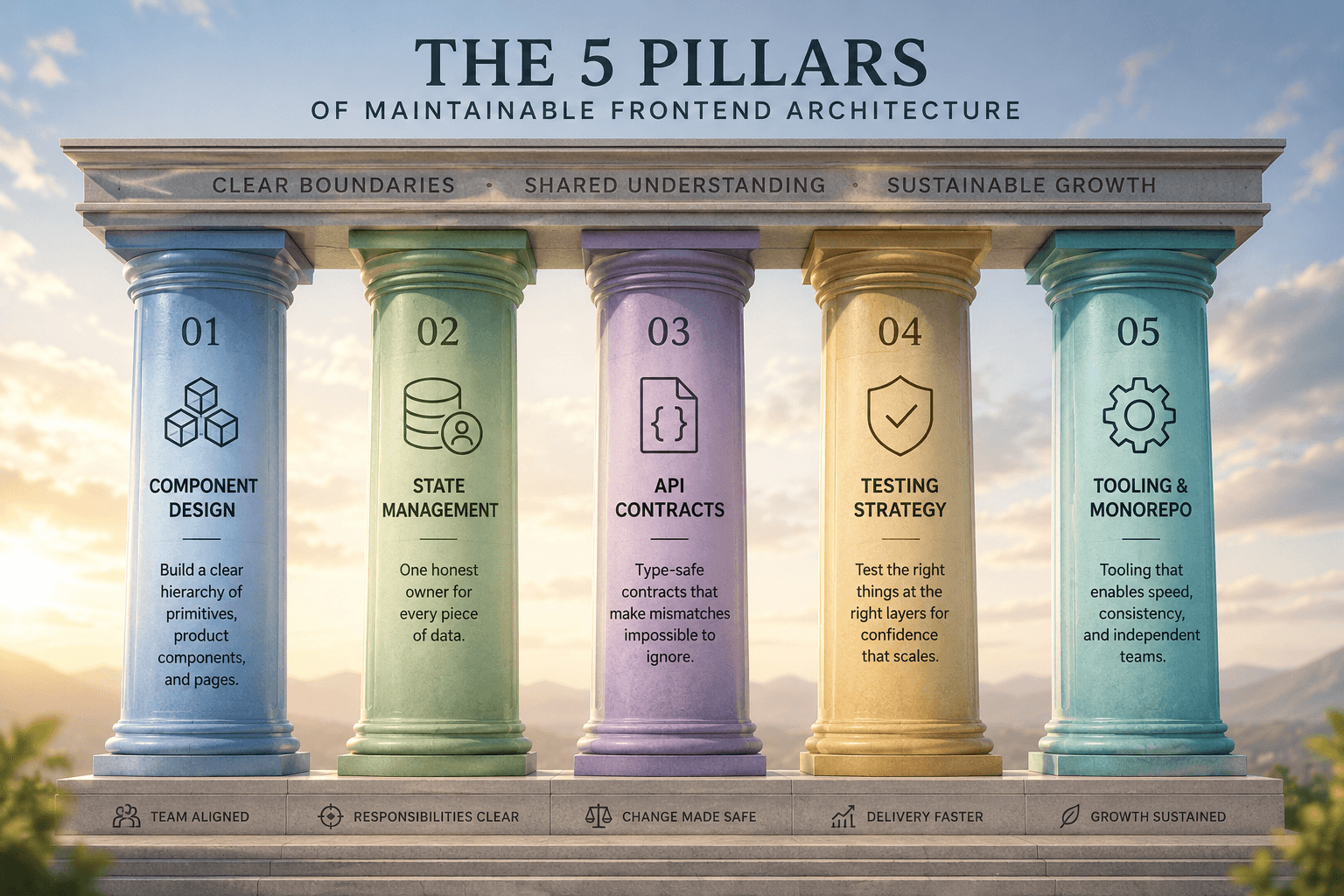
Each pillar answers a specific question the team must be aligned on.
- Component Design - What are the building blocks and how do they compose?
- State Management - Where does each piece of data live and who can change it?
- API Contracts - How do frontend and backend agree on the shape of data?
- Testing Strategy - What do we test at each layer and how fast is the feedback?
- Tooling & Monorepo - How do we share code, enforce rules, and keep the build fast?
Pillar 1: Component Design - boundaries that scale with the team
Separate primitives (look) from product components (meaning) from pages (wiring). Each layer has a different rate of change and a different audience.
The most practical thing you can do for a codebase is decide what a "component" means at each level. A button is not the same kind of thing as a checkout form, which is not the same as a page. When every file is treated as a generic "component," the system has no vocabulary for talking about structure.
I think in three layers. Primitives handle the look - buttons, inputs, cards, layout shells. Product components carry meaning - PricingTierCard, ServiceCard, CheckoutForm. Pages wire everything together - they import product components, pass data, and handle route-level concerns. Each layer imports from the layers below it, never the other way.
Deep dive: I wrote about this in detail in "Shipping React UI Fast Without Making a Mess." That post covers naming conventions, feature folders, and when to promote a pattern to a shared primitive.
tsx
// Primitive: carries look, no business meaning
<Button variant="primary" size="md" />

// Product component: carries product intent
<PricingTierCard
  tier="pro"
  price={29}
  features={['Unlimited projects', 'Priority support']}
/>

// Page: wires it all together
export default function PricingPage() {
  const { data: tiers } = usePricingTiers();
  return <PricingGrid>{tiers.map(PricingTierCard)}</PricingGrid>;
}
Pillar 2: State Management - one honest owner per piece of data
Every piece of state should have exactly one owner. Server state, URL state, local UI state, and global shared state each have a natural home.
The most common source of frontend bugs is not complex logic. It is two pieces of state that claim to represent the same thing but disagree at runtime. A user list in a context, another copy in local state, a third derived from a prop - now you have three truths and no way to prove which one is current.
I draw a grid. Server state belongs in a data-fetching layer (React Query, SWR, or server components). URL state belongs in the router. Local UI state belongs in useState or useReducer close to the component that needs it. Shared global state - theme, auth, preferences - belongs in a minimal provider with Zustand or Context. The rule is simple: if you can derive it, derive it. If you must store it, store it once.
This is its own deep topic.
Pillar 3: API Contracts - TypeScript as the source of truth
Share types between frontend and backend so mismatches become compile errors instead of runtime surprises.
I have lost count of the bugs caused by "I thought the API returned camelCase." The frontend accesses user.profilePicture, the backend sends profile_picture, and the page silently renders a broken image. No error, no warning, just a missing pixel.
The fix is boring and effective. Define your API contract as TypeScript types (or Zod schemas) that both frontend and backend reference. When the backend changes a field name, the frontend fails to compile. Not at 3 AM in production - during the PR review. Tools like tRPC, Zod, or a shared types package in a monorepo make this almost frictionless.
typescript
// Shared contract - one source of truth
export const UserSchema = z.object({
  id: z.string().uuid(),
  displayName: z.string(),
  avatarUrl: z.string().url().optional(),
  role: z.enum(['admin', 'member', 'viewer']),
});

export type User = z.infer<typeof UserSchema>;

// If backend changes "displayName" to "fullName",
// the frontend fails to compile. Good.
Pillar 4: Testing Strategy - confidence without the tax
Test at the layer that gives the most confidence per line of test code. Unit tests for logic, integration for workflows, E2E for critical paths.
The goal of testing is not 100% coverage. It is shipping without fear. The fastest tests are unit tests, but they also catch the least amount of real bugs. The slowest tests are E2E, but they catch the most. The art is knowing where to invest.
My default: unit-test pure logic (utilities, hooks, selectors), integration-test feature workflows (render a page, interact with it, assert the outcome), and write a handful of E2E tests for the critical paths (auth, checkout, data export). This gives high confidence without a suite that takes thirty minutes.
Pillar 5: Tooling & Monorepo - structure that stays out of the way
Shared configs, dependency management, and build caching that let each team move independently without breaking each other.
Architecture is not just code structure. It is also the tooling that enforces and enables that structure. A well-configured monorepo with shared ESLint rules, TypeScript project references, and a fast build cache is an architectural decision as much as any folder structure.
Monorepos get a bad reputation because they are easy to set up and hard to maintain. The key is clear package boundaries - each package owns its types, its tests, and its dependencies. The root config is minimal. Turborepo or Nx handles caching so CI stays fast even as the repo grows.
How the five pillars work together
Each pillar reinforces the others. Strong API contracts make testing easier. Clear state boundaries make component design simpler. Good tooling makes everything else faster to change.
The power of this mental model is not any single pillar. It is the way they interact.
Good component design means less state leaking across boundaries, which makes state management simpler. Strong API contracts mean fewer runtime errors, which reduces the testing surface area. A clear testing strategy gives you the confidence to refactor component boundaries without regression fear. Solid tooling lets you share types across packages, enforce pillar rules automatically, and keep CI fast.
Weakness in any pillar creates pressure on the others. A missing contract layer puts the burden on testing. Unclear state ownership makes components harder to reuse. When all five are healthy, the system has a kind of gravity. New features fall into the right place. Bugs surface in the right layer. The codebase rewards clarity and punishes shortcuts visibly.
- Good component design means less state leaking across boundaries, which makes state management simpler.
- Strong API contracts mean fewer runtime errors, which reduces the testing surface area.
- A clear testing strategy gives you the confidence to refactor component boundaries without regression fear.
- Solid tooling lets you share types across packages, enforce pillar rules automatically, and keep CI fast.
- Weakness in any pillar creates pressure on the others. A missing contract layer puts the burden on testing. Unclear state ownership makes components harder to reuse.
A decision framework for your next feature
Ask four questions before writing code: where does the data live, what shape does it arrive in, what component owns this surface, and how will I know it works?
Before I build anything non-trivial, I run a quick mental scan against the five pillars. Answering these takes five minutes. It saves hours of "where did this bug come from" later.
- State - Is this server state, URL state, or local UI state? Where is its single source of truth?
- Contract - Have I defined the type/schema for the data this feature touches? Is it shared or duplicated?
- Component - Does this introduce a new product component or compose existing ones? Does the naming make intent obvious?
- Testing - What is the riskiest part of this feature? What one test would catch the most likely failure?
- Tooling - Does this feature need a new package, a new config, or a new CI step? Is there already a pattern I can follow?
Services
Need help implementing this?
I build these systems for a living - let's work on yours.
Frontend Architecture & System Design
Structure so teams can ship. Clear boundaries, state strategy, and contracts. New features land cleanly; refactors stay low-risk.
Frontend Development
Production UIs in React, Next.js, or Vue- third-party and payment integrations included. Built for real traffic and maintained in production.
Full Stack Development
End-to-end apps: MERN, React+Node, or MEVN, plus React Native for mobile. Auth, role-based access, and real-time where it matters. Designed to scale without rewrites.
Your turn
- >Did this help you ship something?
- >Which part clicked the most for you?
- >Applying this at work? Share your experience.
Continue
More engineering notes
 SEO
SEOSEO, AEO, and GEO for a Modern Developer Portfolio
How I structure a portfolio so Google, featured snippets, and AI crawlers can all quote me without me sounding like a keyword vending machine.
 Frontend
Mastering Async JavaScript: Promises, Async/Await, and the Microtask Queue
From callback hell to Promise chains to async/await, this guide covers everything about asynchronous JavaScript including error handling, Promise combinators, AbortController, and real-world patterns.
Discussion
Leave a comment
Thoughts, questions, corrections - all welcome.